Monday, October 09, 2006

BUSH'S 'AXIS OF EVIL' DECLARATION COMES BACK TO HAUNT HIM

From the Washington Post :

Nearly five years after President Bush introduced the concept of an "axis of evil" comprising Iraq, Iran and North Korea, the administration has reached a crisis point with each nation: North Korea has claimed it conducted its first nuclear test, Iran refuses to halt its uranium-enrichment program, and Iraq appears to be tipping into a civil war 3 1/2 years after the U.S.-led invasion.

Each problem appears to feed on the others, making the stakes higher and requiring Bush and his advisers to make difficult calculations, analysts and U.S. officials said. The deteriorating situation in Iraq has undermined U.S. diplomatic credibility and limited the administration's military options, making rogue countries increasingly confident that they can act without serious consequences. Iran, meanwhile, will be watching closely the diplomatic fallout from North Korea's apparent test as a clue to how far it might go with its own nuclear program.

"Iran will follow very carefully what happens in the U.N. Security Council after the North Korean test," said Robert J. Einhorn, senior adviser at the Center for Strategic and International Studies (CSIS). "If the United Nations is not able to act forcefully, then Iran will think the path is clear to act with impunity."

Michael E. O'Hanlon, a Brookings Institution scholar and co-author of the new book "Hard Power: The New Politics of National Security," said the U.S. response to North Korea will have ripple effects. "Iran will certainly watch what happens. North Korea watched what happened with Pakistan and decided that the world didn't punish Pakistan too hard or too long," he said. "Iran will certainly notice if North Korea gets treated with kid gloves."

Political strategists debated the domestic implications of the North Korean test with midterm elections four weeks away. Some Republicans predicted it would take the focus off the Mark Foley congressional page scandal and remind voters that it is a dangerous world best confronted by tough-minded leaders. Some Democrats argued it would be seen as another failure of Bush's foreign policy and moved quickly to try to pin blame on the Republicans. "Is this going to help Republicans?" asked Jim Manley, spokesman for Senate Minority Leader Harry M. Reid (D-Nev.). "The answer to that is absolutely not. This is another significant foreign policy failure for the administration."

In Bush's 2002 State of the Union address, a speech designed to shift the political debate from a battle against al-Qaeda to a possible confrontation with Iraq, the president mentioned North Korea, Iraq and Iran and declared: "States like these, and their terrorist allies, constitute an axis of evil, arming to threaten the peace of the world. By seeking weapons of mass destruction, these regimes pose a grave and growing danger. . . . In any of these cases, the price of indifference would be catastrophic."

All three issues came to a head in 2003: The United States invaded Iraq and discovered no weapons of mass destruction; North Korea began to obtain weapons-grade plutonium from fuel rods that had been under international observation; and Iran disclosed that it had made rapid progress with a previously secret uranium-enrichment program.

In contrast to its handling of Iraq, the administration has tried to resolve the North Korean and Iranian nuclear breakouts with diplomacy. But progress has been slow, in part because the United States has been reluctant to hold bilateral talks with either country except within the context of broader talks with other nations.

The administration launched a full-court press yesterday at the Security Council, proposing elements of a tough resolution that would call for imposing an arms embargo and a series of legally binding U.N. financial and trade sanctions. The United States also called for international inspections of all trade in and out of North Korea to enforce the sanctions.

U.S. officials yesterday were focusing especially closely on the reaction of China, long North Korea's main benefactor. The Chinese government publicly denounced the test in unusually strong language, and a senior U.S. official said the private comments of Chinese officials were equally strong. While China has been reluctant to pressure North Korea, fearing a collapse of the government and mass refugees on its border, "the question is whether a chaotic North Korea is worse than a nuclear North Korea," the official said, speaking on the condition of anonymity because of the diplomatic sensitivities.

Secretary of State Condoleezza Rice appears likely to make a trip to the region soon to further build support for a tough response by China, Japan and South Korea. Several experts predicted that although China's leadership is angry enough to support some sanctions, it always will stop short of putting enough pressure on Pyongyang to force its collapse.

NORTH KOREA'S BIGGEST BANG

CLAIMS NUCLEAR TEST "SAFE" AND "SUCCESSFUL"

EXPECTED WORLD OUTRAGE FLOWS AS UN SECURITY COUNCIL MEETS


North Korea has conducted its first test of a nuclear weapon, a test it claims was "successful" and "safe".

Most world leaders expressed outrage and dismay, as expected.

It's one of the biggest stories of the year, and one of the biggest of this Fourth World War, not only because the test finally confirms that North Korea now truly does have nuclear weapons, but also because of the way the test has immediately altered the alliances of South and East Asia.

One of the first, and most immediate, fallout effects that North Korea may not have been counting on is that Japan is now siding with China and South Korea, an unofficial 'alliance' that North Korea's Kim Jong-Il could not have seen coming, expecting as he would have that China would have continued to back North Korea. But China has condemned the tests, unreservedly, as has Russia, and neither statements from the nuclear-nations appear to be just cover.

North Korea now joins the United States, Israel, the UK, France, China, Pakistan, India and Russia as a nuclear armed power. And they may be preparing a second test.

But little is known about the number of nuclear bombs North Korea possesses, and in particular if they are able to attach the warheads to intercontinental missiles, bringing US-backed countries like Australia and Japan into their line of fire.

Although the outrage being heard around the world today is loud and united, there seems to be little the US, or the UK, or Russia and China can do outside of invasion or nuking what they can now determine to be North Korea's nuclear facilities.

More embargoes and sanctions are unlikely to hurt the regime, and will only starve and disable the population of North Korea further.

It is an interesting quandry for the world powers, particularly Australia, the UK and the US, who have all stated clearly, at various times, "We cannot live with a nuclear armed North Korea".

North Korea is now armed with what experts believe may be as few as two or three weapons. So what is the world going to do about it?

Australian and American politicians are pointing at the UN, saying this is the time for the UN and the Security Council to prove its worth. That may also be a convenient way for Australia and the US to hold the UN to account, and take attention off themselves, as they are unlikely to take any military action against North Korea on their own, or together, outside of possible unnofficial special operations entries and sabotage attempts.

Here's some of the world reaction and the more interesting news and opinions (clink the links, as usual, for the full story) :

Japan Deploys Military Jets To Assess Radiation Levels Over Sea Of Japan


A BBC 'Factfile' On Underground Nuclear Testing

The Reaction From World Leaders

Russian Defence Minister Says NK Bomb Could Have Been As Big As Hiroshima's - Russia Warned Two Hours Before Test

NK's 'Unofficial' Spokesman Claims Next Korean War Will Be With The US - Major Cities Will Be "Transformed Into Towering Infernos

Bush Talks To Russia, China, Japan, Says UN Security Council Will Make "An Immediate Response" But Condemnation And Talk Of Sanctions First Business


Pyongyang's 60 Year Long Obsession With Gaining Nuclear Weapons

'Landscape Of Alliances' Altered In East Asia As Nuke Tests Force Japan Into Siding With China and South Korea
THE NEW NEW BUSH DOCTRINE

THE MIDDLE EAST DEMOCRACY EXPERIMENT WINDS DOWN


President Bush still refuses to acknowledge what the rest of the world already knows, along with a growing majority of Americans : The 'democracy experiment' in the Middle East has failed, the 'War On Iraq' is a disaster, and the 'War On Afghanistan' is rapidly going the same way as Iraq.

So it's time for Bush to change the tune he's been singing for near on five years.

It's not all about bringing democracy into the Middle East and Afghanistan anymore, now it's about dividing the "moderates" from the "extremists", though the definition of "extremist" is as vague as the 'Global War On Terror' definition of "terrorism". Even as we move into the sixth year of the GWoT, there is still not an international consensus on what determines an action to be an "act of terrorism".

The new song Bush is singing is all about "idealogies" of hatred, and extremism, and how they must be "defeated". But leaders across the Middle East are growing impatient with Bush Co. They know one of the greatest motivators, and recruiting agents, for "extremist idealologies" is the bloodbath that is the 'War On Iraq' and the never-ending humiliation of the Palestinian people by Israel.

Terrorism barely gets a mention anymore in Bush speeches, which also means, then, that the 'T' word is rarely uttered by coalition leaders like British prime minister Tony Blair and Australian prime minister John Howard.

For Bush Co now, it's all about the "extremists". It's the new new Bush Doctrine.

From the Boston Globe :

Belatedly, the debate in (the Bush) administration appears to have been won by those who recognize that equating successful counter-terrorism with implanting democracy is naive (witness the exploitation of democracy by Hamas, Hezbollah, and militant Shi'ites in Iraq), and also embarrassing to intransigently undemocratic governments (like Pakistan) that the United States is courting, not only for help in combating terrorism but also for reasons of arms control, access to energy, military bases, and hospitality to US investments (including Jordan, the United Arab Emirates, Kazakhstan, and of course China).

...the renewed recognition of Afghanistan as the flashpoint in the effort to eradicate Al Qaeda and a realistic backing away from hubristic neoconservative illusions about democratic peace growing out of the barrel of a gun...should be welcomed, despite their obvious purpose of shifting the political spotlight away from the administration's gross ineptitude in Iraq.

The new Bush doctrine of supporting "moderate" regimes and movements against the extremists sounds like a realistic accommodation to the reality that not all those upon whom the United States depends for its security and well-being can pass a litmus test for democracy and human rights.


More on the failure of the 'GWoT' as an avenue to encourage, or scare, democracies into life across the Middle East from the Globe and Mail :
A year ago, Condoleezza Rice arrived in Cairo preaching about the importance of spreading democracy in the Middle East, even if that meant risking other short-term goals.

"The U.S. pursuit of stability in the Middle East at the expense of democracy has achieved neither," the U.S. Secretary of State told an audience at the American University in Cairo.

No one needed to be told that she was referring to the long-held U.S. practice of propping up unloved autocrats like Egypt's Hosni Mubarak or Saudi Arabia's Royal Family.

"Now we are taking a different course," she promised. "We are supporting the democratic aspirations of all people."

Ms. Rice arrives in Cairo today to give a very different message at a mini-summit with the foreign ministers of Egypt, Jordan and Saudi Arabia, as well as the Persian Gulf kingdoms of Kuwait, Bahrain, Qatar, Oman and the United Arab Emirates.

All eight countries are U.S. allies in the war on terrorism, but none have democratically elected leaders.

The electoral advance of the Islamists (Hizbullah in Lebanon, Hamas in Palestine) has forced the Bush administration to return to the same old prayer book that it made a show of throwing out a year ago: embracing repressive monarchs and dictators as "moderates" and friends in Washington's battle against Islamic extremism.

The summer war between Israel and Hezbollah, Ms. Rice suggested yesterday, forced the strategic rethink.

"When Lebanon happened, I think [we] got in very stark relief a clear indication that there are extremist forces and moderate forces [in the Middle East]," she said to reporters travelling with her. "The countries that we are meeting . . . is a group that you would expect to support the emerging moderate forces in Lebanon, in Iraq and in the Palestinian territories."

Ms. Rice is expected to ask the Arab regimes to aid the region's wobbling pro-Western leaders, Palestinian president Mahmoud Abbas, whose loyalists have fought bloody street battles with Hamas gunmen in recent days, and Lebanese Prime Minister Fouad Siniora, who faces a challenge to his authority from Hezbollah's popular leader, Hassan Nasrallah.

She'll also ask the eight Sunni regimes to try to encourage Iraq's alienated Sunnis, who increasingly look to be at war with the U.S. supported Shia-led government in Baghdad, to join the limping political process in that country.

The Lebanon war, however, illustrated that many of the leaders she is appealing to are badly out of touch with their own people. While the Egyptian, Jordanian and Saudi governments all initially condemned Hezbollah for instigating the conflict, obediently toeing the U.S. line, Mr. Nasrallah and Hezbollah became folk heroes on the streets of many Arab capitals for standing up to what many saw as U.S.-sponsored Israeli aggression.

"The Bush administration has yet to signal any change of heart toward this region, which has suffered terribly due to the muddled and biased foreign policy," read a scorching editorial...in the state-run Egyptian Gazette...

"The Arabs have lost hope that this administration will do anything to resolve the problems, but they cannot admit this publicly," said Diaa Rashwan, a political analyst at the al-Ahram Centre for Political and Strategic Studies in Cairo.

Egypt's own democrats, meanwhile, say they've stopped believing that the Americans are allies in their struggle to attain more freedoms.


It Was All About Iran - The Reasons Behind US Sec. Of State's Tour Of The Middle East

Syria Claims US Lacks Realistic Vision For Peace In The Middle East

What Does The United States Want From, and For, The Middle East? Condi Rice's Six Trips To The Region In Eighteen Months, But No Signs Of Peace Progress

Condi Rice's Utterly Baffling MidEast Six Day Tour - Nothing Achieved, No Commitments Made For Change

Wednesday, October 04, 2006

NUCLEAR BRINKMANSHIP RAISES TENSIONS, JITTERS ACROSS THE WORLD

FIRST IRAN, AND NOW NORTH KOREA DEFY UNITED STATES AND THE UN

"WE WILL TEST OUR NUCLEAR WEAPONS," SAYS NORTH KOREA


North Korea is raising tensions across the world tonight as the leadership claims it will press ahead with at least one test of its nuclear weapons. The test is expected to be conducted underground, but analysts are still not sure if the Democratic Peoples' Republic of Korea is just bluffing.

There is no doubt North Korea has nuclear weapons now, with the consensus figure being around eight completed warheads.

North Korea claims it needs nuclear weapons to defend itself from the United States, and said it would never use any nuclear weapons to strike another country pre-emptively. That is, North Korea is claiming it would only use its nuclear weapons for retaliation if there are strikes by the US or NATO countries inside the lands controlled by the last vestige of Stalinism left in the world today.

Iran, meanwhile, is resisting pressure from the EU to halt its uranium enrichment programs to allow time for full negotiations to be conducted over its plans beyond nuclear energy production. Iran still claims it does not want, and does not neeed, nuclear weapons. Although there is no shortage of Iranian exiles and American NeoCon media and politicians claiming otherwise, the International Atomic Energy Agency has found no proof that Iran has, or is planning to produce, nuclear weapons.

The IAEA recently dismissed a US senator's report on Iranian nukes as completely lacking in evidence or credibility.

North Korea and Iran obviously are feeling little true pressure from the US or the EU, rightly believing that military strikes at their nuclear facilitites, or within their borders, is a likelihood within the next twelve months.

The United States has already brought itself more time on the Iranian Nukes Crises by passing the negotiations off onto the EU for the moment, claiming diplomacy is the best solution for now. On North Korea, the United States' Secretary of State, Condoleeza Rice, said today that it should not be just up to the US to deal with North Korea and its nuclear arsenal. Rice hinted that countries in the region should be more pro-active in reigning in North Korea.

In Australia, the Foreign Affairs Minister, Alexander Downer, was also qouted as saying that the US should not be turned to, or relied upon, to sort out all the disputes in the world today, and that countries like Japan and China, and also Australia, should be dealng with North Korea and sorting out the problems posed by Kim Jong-Il's regime for themselves.

The United States has no choice but to pull back from the front rows of the current crises with North Korea and Iran. Not only because they are fighting too massive insurgencies and fertile Islamist resistances across Iraq and Afghanistan, but also because they are easily accused of hypocrisy when it comes to who should, and who should not, have clear weapons.

The United States' can allow Israel and Pakistan and India to have nuclear weapons, but says Iran and North Korea cannot be trusted. But Israel has been acting with beligerent violence and retaliation towards its neighbours in Lebanon and the Occupied Palestinian Territories, while India and Pakistan have engaged in wars with each other for decades and peace between the two nuclear nations is always, at best, a cooling of tensions.

From the Independent :

The statement from the North Korean Foreign Ministry said that the (nuclear) test would be conducted "in the future" and "under the condition where safety is firmly guaranteed".

Also yesterday, hopes that Iran could be coaxed into curbing its nuclear programme faded after the European official who had been holding discreet talks with the chief Iranian negotiator informed European ministers and the US that they had failed.

Western experts believe that although Iran and North Korea are not co-ordinating their strategy, they are carefully watching how each other's actions are playing out.

The long-running dispute with both countries is now entering an unpredictable phase, with uncertainty over how Iran may react to possible UN sanctions.

Tehran may be tempted to carry out its threat of using oil as a weapon, or even pull out of the nuclear non-proliferation treaty, as North Korea did in 2002.

But although the White House and State Department warned that a "provocative" and "reckless" test would only lead to further isolation for Pyongyang, Washington signalled its preference to resolve the dispute through diplomatic channels.

In an early sign of the tough line being taken by the new government headed by Shinzo Abe in Japan, the Foreign Minister, Taro Aso, called the North's nuclear test plans "totally unforgivable," and said Tokyo would react "sternly" if the North conducted a test.


Diplomats Say Iran Negotiations Have Failed, UN Security Council Atomic Sanctions Loom

North Korea Tells United States To Pull Its 30,000 Troops Out Of South Korea - Claims US Presence Stopping North And South Co-Operation

Iran To Open Nuclear Sites To Tourists

China, North Korea's Closest Ally, Urges Calm But Refuses To Condemn Tests - China Warns Britain, United States, Japan And Australia "Not To Take Actions That Raise Tensions"

South Korea Urges North Korea To Cancel Nuclear Tests : DPRK Says Tests Will Be "Safe"

Sanctions By The West Won't Stop North Korean Nukes

Monday, October 02, 2006

BURMA : THE DARK SECRET OF THE UNITED NATIONS

WAR AGAINST DEMOCRACY RAGES INSIDE SOUTH EAST ASIA'S NUMBER ONE POLICE STATE

BUT THE OIL AND CASH FLOWS, TO FRANCE AND BRITAIN

For more than 40 years, Burma has been ruled by a brutal military junta that has done everything it can to destroy the hopes of any Burmese that democracy will ever return to their dark corner of South East Asia.

But that hasn't stopped investment dollars centred around the oil industry from flowing into the military's hands from France and the UK, amongst the many countries who turn a blind eye to regular massacres and the brutal crushing of any and all dissent.

More than 600,000 people have been killed, and more than 1million people displaced.

But in the next few weeks, for the first time, the issue that is Burma will get some attention at the United Nations.

Real change, and the return of democracy, may still take years, and a bloody uprising, to manifest.

But are the Guardians Of Freedom really that interested in Burma?

Not yet. But they might be soon.

New oil and gas reserves have been discovered in Burma, and they're enormous.

Now the West knows there is real money, tens of billions of dollars and more, to be made in Burma, democracy might just get another look in.

From the UK Independent :
...Burma is still in the grip of a ruthless military dictatorship that refuses to hand over power to the elected National League for Democracy and carries out regular attacks on civilians from the country's many ethnic minorities. Those who refuse to bow are either killed or forced into slave labour and subjected to the arbitrary rule of local military commanders.

....the military junta - which has had the democratically elected leader, the Nobel peace laureate Aung San Suu Kyi, under house arrest for almost 11 years - survives only because foreign companies remain keen to tap into the country's rich natural resources.

The ruling military junta has ensured that Burma remains isolated. Cut off even from its closest neighbours, Thailand and India, the conflict that rages at its heart gets little attention.

On Friday, for the first time, the UN Security Council discussed Burma, and the US is expected soon to submit a draft resolution criticising Burma's human rights record and demanding Aung San Suu Kyi's release.

But none of that will matter if the regime continues to reap the rewards of foreign investment.

The military junta's policies have led to more than 600,000 deaths and up to one million people being displaced. Mortality rates among the young in what was once the rice basket of Asia are now among the highest in the world.

The World Health Organisation ranks Burma second to bottom in its list of 191 countries around the world....

Of all the weapons at the Burmese army's disposal, rape is the cheapest. Soldiers are often ordered to rape women from ethnic minorities and leave them pregnant to breed out the resistance.

Archbishop Desmond Tutu said that the time to act is now.

"The Burmese people have tried everything possible and have been flatly refused help. The regime is only getting stronger. There comes a point where it is better to die on your feet than live on your knees."

Go Here To Read The Full Story
RUSSIA IN EDGE-OF-WAR CRISIS WITH GEORGIA

PUTIN DEFIES US OVER IRAN, GEORGIA, AS RUSSIA BECOMES CONTROLLER OF HALF OF WORLD'S ENERGY RESERVES

Russia is all over the news this past month.

The 'Spy Crisis' with neighbouring Georgia is just the latest headline grabber, and appears to be more about backing the United States out of the region than major concerns about how Georgia detaining spies linked back to Putin's Kremlin.

From killing the US sanction that were directly aimed at destroying Iran's booming economy and supplying Iran with nuclear fuel for its contentious nuclear energy program, to quietly soaking up the majority of the world's oil and energy reserves, Russia is using this time when the United States is crippled by a series of crises of its making (monstrous foreign debt, the wars in Iraq & Afghanistan) to reassert itself on the world stage as a rising new superpower.

One that could soon rival, and overtake, Bush's America.

China, meanwhile, is happy to get cheap acccess to Russia's energy while the EU grows nervous about being outbid on Russia's essential energy pipeline supplies.

And together, Russia and Chin are moving on Africa's energy resources, outbidding the US for the best raw fuels and the most likely sites to uncover new oil and gas reserves.

Russia is set to enter something close to a new Golden Age of power and prosperity. But the US is unlikely to let it dominate the world (via China, Iran and Africa) without a fight.


PRESIDENT BUSH SIGNS NEW SANCTIONS BILL TARGETING IRAN'S KEY ALLIES, CHINA AND RUSSIA


Although it does not name any countries, the (sanctions) measure is seen as a clear warning to Russia and China, two permanent members of the UN Security Council that have resisted calls for new international sanctions against Tehran in response to its refusal to halt uranium enrichment...

Russia is involved in an 800-million-dollar project to help Iran build a nuclear power plant in Bushehr and sells it modern weaponry. China has been accused of supplying the Islamic republic with advanced missile technology.


RUSSIA COULD SOON CONTROL 50% OF WORLD'S OIL AND GAS RESERVES

Most likely (the) Kremlin's next step will be a very close relationship with Canada and some of the countries in Middle East. That will make Russian Oil Block even stronger.


GEORGIA BULKS UP MILITARY AGAINST RUSSIA WITH US HELP AS 'SPY CRISIS' GROWS MORE INTENSE


....Much to the discomfort of Russia, the United States has been supplying Georgia with military training and some equipment. Partly, this is in response to Georgia's sending of 800 peacekeepers to Iraq.

The principal reason for the military build-up is the existence of secessionist regimes in two provinces, Abkhazia and South Ossetia. There are also some 6,000 Russian troops, leftovers from Soviet Union era garrisons. Georgia has been trying get all the Russian soldiers out since the Soviet Union collapsed (and Georgia became independent once more) in 1991.


PUTIN ACCUSES GEORGIA OF "STATE TERRORISM", USING TACTICS FROM STALIN ERA

Russian President Vladimir Putin accused Georgia of state terrorism and adopting tactics similar to the secret police of Joseph Stalin after the former Soviet republic put four Russian officers on trial for spying.

The arrests are "an act of state terrorism involving hostage-taking,'' Putin, 53, told a meeting of Russia's Security Council in Moscow yesterday...


RUSSIAN LONG RANGE BOMBERS ENTER UNITED STATES AIRSPACE 'BUFFER ZONE'

Russian long-range bombers flew within 15 miles of U.S. airspace off Alaska, Denver Post website reported.

Fully-armed U.S. fighter jets responded, intercepting the two bombers...


RUSSIAN SHIPS JOIN TURKISH SECURITY OPERATION

Russian ships have started a mission in the Black Sea in line with a Turkey-led international operation designed to combat terrorism and prevent the proliferation of nuclear weapons, the Navy's press service said.

In March 2004, Turkey proposed a new security initiative, Black Sea Harmony, as a move to improve communication and shadow suspicious ships, and has recently invited other littoral states, including Russia and Ukraine, to participate in the operation.

Some countries consider Black Sea Harmony an attempt to maintain Turkey's dominance in the area by preventing NATO from extending its Operation Active Endeavor, which has similar objectives in the Mediterranean, into the Black Sea.


PUTIN'S RUSSIA FACES GROWING CHORUS OF CRITICISM FROM UNITED STATES


The “solid friendship” that President Bush cited last month in describing his relationship with Russian President Vladimir Putin is now stacked against growing criticism for Putin’s alleged attempts to revert Russia to a “police state.”

....(Russia is on) Iran’s, not America’s, side, when it comes to the controversy involving Iran’s nuclear program.

“The Russians have built the Iranian nuclear capacity. The Russians have provided the Iranian government with the most advanced anti-aircraft system available to them in order to prevent an American-Israeli strike against those people who, among other things, call for the elimination of the State of Israel from the map of the world...”
US SET TO SIDELINE ISRAEL FOR FOR NEW ALLIANCE WITH IRAN

THE ULTIMATE NEOCON NIGHTMARE IS SUDDENLY COMING TRUE

It has been a bitterly debated subject across message and discussion boards throughout Israel and the US for weeks, but this is the first actual discussion we've seen about this in the mainstream media.

That this story appeared in one of Israel's largest newspapers, Haaretz, only adds to the signficance of recent events that may lead to the US not going to war against Iran, but developing a 'new relationship' with this sworn enemy of Israel's Zionist government.

It is certainly no great secret that Israel's influence within Washington's corridors of power has been sliding in the past few years. It was the Israel-backed NeoCon crowd that demanded, and got, a War On Iraq, and since the War On Iraq has proved a costly, draining and politically devastating failure, the NeoCons are finding they just don't have the power and influence they once did.

Even though Iraq is now a democracy, and is likely to find peace and staibility within a few years, President Bush is no longer receiving top advice from NeoCon Israelis. Advisors from the former President Bush's circle of influence - Henry Kissinger, James Baker III - are now in a part of his inner circle, advising the president of what he needs to know, and what he should do next.

This is mostly why President Bush has been pushing diplomacy in solving the Iran Nuclear Crisis. That and the fact that he would face something close to a revolution within his own military if he tried to send battalions of ground forces into Iran.

From Haaretz.com :
It is hard to believe that the following series of events, all of which took place within a short period, occurred by chance, without a guiding reason. Suddenly, despite the harsh threats voiced by the White House against Iran for trying to produce nuclear weapons, the world learned that Iran's former president, Mohammad Khatami, received a tourist visa to visit the United States. He was not invited to official meetings, but President George Bush himself approved the visa request.

Afterward, the president of Iran, Mahmoud Ahmadinejad, received a visa for the United Nations General Assembly, and also an invitation to appear in New York before the Council on Foreign Relations. Shortly before this, the prime minister of Iraq, Nuri al-Maliki, visited Iran and held talks with its leaders. It is hard to believe that this visit by the Iraqi leader could have been made without coordination with Washington.

As though by chance, in the same week when Khatami was in the U.S., Bush invited a well-known correspondent for the Washington Post, David Ignatius, to interview him in the White House.

The interview dealt with one subject alone: Iran. And it indicated a substantive shift in Bush's approach. He did not threaten military action against Iran, he did not even mention sanctions. He made do with saying that deep concern exists in view of the desire by some of Iran's leaders to develop nuclear weapons and the possibility of their attempting to make good on their declarations about attacking Israel and threatening the U.S.

It is worth reading Bush's remarks closely in order to understand the singularity of this interview. America recognizes Iran's role "as an important nation in the Middle East," Ignatius noted on the basis of the interview, and went on to quote Bush: "I would say to the Iranian people: We respect your history. We respect your culture ... I recognize the importance of your sovereignty  that you're a proud nation ... I understand that you believe it is in your interest  your sovereign interest, and your sovereign right  to have nuclear power ... I would want to work for a solution to meeting your rightful desires to have civilian nuclear power. I would tell the Iranian people that we have no desire for conflict." Bush added that he would like to see programs for "cultural exchanges" and "university exchanges" between the U.S. and Iran.

It is not surprising that Ignatius concluded that the Bush administration is seeking a diplomatic solution to its clash with Iran over the nuclear issue. Concurrently, reports have been published about cracks that have appeared in the "iron triangle" of Bush, Vice President Richard Cheney and Defense Secretary Donald Rumsfeld. The latter is apparently skeptical that a military option exists against Iran, should it go on developing nuclear weapons.

The conclusion from all these developments is that the current tendency in the U.S. administration is to support an attempt at dialogue with Tehran.

If an American-Iranian dialogue ensues, Israel will not be invited to take part in such talks, as it was not invited to contribute to the agreement that Washington and London worked out with Libyan leader Muammar Gadhafi.
There are no shortage of Israelis who are willing to back nuclear strikes on Iran, to take out their potential nuclear weapons capability, using the pre-emptive strike by the US on Iraq as the example of how and why it should be done.

This view was widespread in the Zionist dominated Israeli media earlier in the year, and this Jerusalem Post columnist provides an example of that kind of thinking :
Despite all the skepticism, the US and Israel do have a military option in Iran: preemptive nuclear annihilation.

The US and Israel, or the US by itself, or maybe even Israel by itself, can destroy Iran and its 69 million people, probably in a matter of hours or even less, and then nobody in the world will have to worry about those crazy maniacs getting the bomb. Things would be sort of weird afterward, it's hard to say what the consequences might be, but the Iranian threat would be behind us.

But that is not the reality that Israel now faces. The US has already put the dampner on air bombing campaigns on Iran's nuclear energy facilities, and faces something like a revolt within its own military should it try and send in ground forces.

Israel has noticed this change in war plans and the same JPost.com columnist spells out the new reality for those Israelis hungering for nuclear annihilation of Iran. It's not going to happen :
A country, even the US or Israel, can't just snuff another country because of what it thinks that country might do to it in the future. Some of you may be asking: "Why not?" I'd explain, but it would probably make you angry. That's just the way it is - no mushroom clouds for Iran. All you can do is dream.

Top US Intelligence Analysts Have Told Bush Ameica Must Get Used To Living With A Nuclear Iran

Iran Rejects EU Terms For Nuclear Talks

Israel Will Be Forced To Accept Same IAEA Safeguards For Its Nuclear Facilities As Iran

How Israel Is Engineering The "Clash Of Civilisations"


Zionist Regime Is Collapsing, Claims Iran's Army Chief


Israel Calls Iran Its Greatest Threat
BRITISH SOLDIERS IN "HISTORIC FIGHT" TO HOLD ONTO BESEIGED AFGHANISTAN BASE

HOW AND WHY BRITS CUT SECRET CEASEFIRE DEAL WITH TALIBAN


One of the most remarkable and intense battles British soldiers have faced so far in Afghanistan saw engineers and military policemen fighting alongside outnumbered troops in a fight to save their Sangin base from being over-run by militants. RAF airstrikes were "utterly, utterly useless" claimed the major in charge, at stopping the ceaseless flow of enemy fighters.

The incredible details of months of hardcore fighting came in a series of leaked e-mails from Major Loden, providing one of the most frank, and informative, word pictures of the 'War On Afghanistan' we've seen so far.

From the Times of London :

On Loden’s first day at Sangin, the British attacked a group of Taliban, only to discover that two other groups were waiting for them. The hero of that engagement was Corporal Bryan Budd (29 years old)...

“We initiated a contact with enemy pre-seen,” Loden said. “Unfortunately the pre-seen were only one of the three firing points and two of Budd’s section were quickly wounded. He pushed forward to drive the enemy back, and personally dispatched some enemy taking cover with a couple of grenades and some rifle fire.”

************************

With intercepts of Taliban communications showing that they were trying to surround the troops, Loden began putting together two more sections using engineers and two military policemen who had been investigating the accidental death of another soldier.

“The company sergeant-major made another trip out and back on the quad bike to collect the third casualty, this time coming under fire himself but continuing nonetheless,” he said. “I began assembling more forces to push out to bolster the position on the ground. I sent forward a section of engineers with the second platoon commander to effectively control the rear.

“The second platoon commander tried to push round the flank towards Budd but was engaged by enemy across the river and pinned down. I now created two more sections, one led by a corporal from the sniper section with an engineer staff sergeant as the second-in-command and including the Royal Military Police sergeant and corporal.”

At this point there were 80 troops on the ground while Loden himself co-ordinated artillery, mortars and air support.

...with Taliban mortars beginning to home in on the British troops, the first platoon found Budd.

“It was around an hour since he had been hit, and initially (he) had no pulse,” said Loden. The troops tried to resuscitate him. “The company sergeant-major raced out on the quad bike and retrieved him, but the doctor was unable to save him.”

Budd, 29, who lived with his wife Lorena and their daughter Isabelle in Ripon, North Yorkshire, was the seventh British soldier to die in Sangin in the past few months.

In an extremely controversial move, British troops fighting Taliban in Musa Qala, in south Afghanistan, cut a secret deal with their enemy for all fighters to pull back from the town, for the safety of the residents.

The Taliban may well claim they beat the Brits down and forced them to leave the area, but the Brits saw the need to "win the hearts and minds" of the locals as being of more strategic value than killing a few more Taliban.

From the Times of London :

Over the past two months British soldiers have come under sustained attack defending a remote mud-walled government outpost in the town of Musa Qala in southern Afghanistan. Eight have been killed there.


It has now been agreed the troops will quietly pull out of Musa Qala in return for the Taliban doing the same. The compound is one of four district government offices in the Helmand province that are being guarded by British troops.

Last month Sir Richard Dannatt, the new head of the British Army, warned that soldiers in Afghanistan were fighting at the limit of their capacity and could only “just” cope with the demands.

The soldiers risk sniper fire and full-scale assaults from experienced Taliban fighters who can then blend into the local population after each attack.

The peace deal in Musa Qala was first mooted by representatives of the town’s 2,000-strong population. About 400 people living in the immediate area of the district centre compound have been forced to evacuate their homes, most of which have been destroyed in the fighting.

Brigadier Ed Butler, the commander of the British taskforce, flew into Musa Qala 18 days ago, guarded only by his military police close-protection team, to attend a shura, or council of town elders, to negotiate a withdrawal.

Butler was taken in a convoy to the shura in the desert southeast of Musa Qala where the carefully formulated proposals were made.

The deal — and the avoidance of the word ceasefire — allows both sides to disengage without losing face, an important aspect in the Afghan psyche.

An e-mail from one soldier in the region explains the issues further :

“We are not having an effect on the average Afghan.

“At the moment we are no better than the Taliban in their eyes, as all they can see is us moving into an area, blowing things up and leaving, which is very sad.”

A total of 29 British servicemen have lost their lives in southern Afghanistan in the past two months...

300 "Militants" Killed In 'Operation Mountain Fury' - 7000 Coalition Forces And Afghan Troops Go Into Battle In East And Central Afghanistan - Taliban Claim Only Dozens Killed

NATO Fails To Find Any Countries Will To 'Volunteer' 2500 Extra Troops For Afghanistan

Britain Accused Of Hiding Its True Casualty Figures In Afghanistan And Iraq - Two To Three Times Higher Than Officially Acknowledged


Spiegel Online Special Feature : Sheer Desperation Driving Afghanis Back Into The Hands Of The Taliban - 'Holy Warriors' In Control Of Entire Regions As They Draw The West Deeper Into Bloody War
US SENATE OKAYS AMERICA'S LARGEST EVER DEFENCE BUDGET

$US448 BILLION, $US70 BILLION MORE FOR WARS IN IRAQ & AFGHANISTAN


Here's how the core of the new US Defence Budget breaks down :

$70 billion for military operations in Iraq and Afghanistan, including personnel and maintenance costs, $23 billion to replace worn equipment, $1.9 billion for new jammers to counter improvised explosive devices in Iraq and Afghanistan, and $3.2 billion to train and equip Iraqi and Afghan security forces.

$86 billion in personnel costs to support 482,400 Army soldiers and 175,000 Marines, and to provide a 2.2% across-the-board pay raise for military personnel

$81 billion for new weapons, including 20 F-22A aircraft, 22 C-17 transport aircraft, 9 C-130J aircraft, two F-35 Joint Strike Fighters, two ultramodern Navy DD(X) destroyers, two high-speed Littoral Combat Ships and one Virginia class attack submarine.

$76 billion for research and development.

$120 billion for maintenance and operations.

$9.3 billion for missile defense programs.

$3.5 billion for the Army's Future Combat System, which would produce more than a dozen manned and unmanned vehicles and aircraft.

It's an astoundingly good time to be an American defence contractor. They haven't had it this good since the glory days of the Cold War, when billion dollar development deals for new surveillance aircraft were passed without plans or even the facilities to build such planes in place.

The next Defence Budget is expected to be even higher than this one. And the fact that the Democrats may control the Senate is unlikely to change the steady increase in defence spending by the US. Both Democrat and Republican senators are lobbied furiously by US defence contractors. That is not going to change any time soon.

From USA Today :

The Senate unanimously approved $70 billion more for military operations in Iraq and Afghanistan Friday as part of a record Pentagon budget.

The bill, now on its way to the White House for President Bush's signature, totals $448 billion. It was passed by a 100-0 vote after minimal debate.

Approval by a comfortable margin came despite intense partisan divisions over the course of the Iraq war, which is costing about $8 billion a month. Another infusion of money will be needed next spring.

At the White House, President Bush said he would sign the bill and thanked Congress "for passing legislation that will provide our men and women in uniform with the necessary resources to protect our country and win the war on terror."

"As our troops risk their lives to fight terrorism," he said, "this bill will ensure they are prepared to defeat today's enemies and address tomorrows threats. I look forward to signing this bill into law."

The House-Senate compromise bill provides $378 billion for core Pentagon programs, about a 5% increase, though slightly less than President Bush asked for. The $70 billion for Iraq and Afghanistan is a down payment on war costs the White House has estimated will hit $110 billion for the budget year beginning Oct. 1.

Congress has now approved $507 billion for Iraq, Afghanistan and heightened security at overseas military bases since the Sept. 11, 2001, attacks, according to the Congressional Research Service. The war in Iraq has cost $379 billion and the conflict in Afghanistan now totals $97 billion.

The Iraq war continues to be unpopular with voters, according to opinion polls, but even Democratic opponents of the war voted for the Pentagon measure, which provides funding for body armor and other support for U.S. troops overseas.

"America is in deep trouble in Iraq," said Edward Kennedy, D-Mass. "The continuing violence and death is ominous.... Militias are growing in strength and continue to operate outside the law. Death squads are rampant."

The growing price tag of the Iraq conflict is partly driven by the need to repair and replace military equipment worn out in harsh, dusty conditions in Iraq and Afghanistan or destroyed in battle. Almost $23 billion was approved for Army, Marine Corps and National Guard equipment such as helicopters, armored Humvees, Bradley armored fighting vehicles, radios and night-vision equipment.

Lawmakers allotted $1.9 billion for new jammers to counter improvised explosive devices in Iraq and Afghanistan and $1 billion is provided for body armor and other personal protective gear.

There is also a stack of pet projects for lawmakers' homes states and districts, including $372 million obtained for Hawaii, home of Daniel Inouye, top Democrat on the defense appropriations panel.

"There are 2,000 earmarks in the bill directed by Members of Congress — somewhere around $8 billion — and a large portion of those don't have anything to do with the mission of the Defense Department," said Tom Coburn, R-Okla.

The legislation would be the first of 11 spending bills to clear Congress for the new budget year. The homeland security bill is the only other ready to pass before Congress leaves Washington this weekend. Nine bills funding domestic programs and foreign aid will wait until a lame duck session. That means delays in funding increases for veterans health care.

So little progress has been made on other bills that the Pentagon measure also carries a stopgap funding bill to keep open through Nov. 17 agencies whose funding bills won't have passed. Only the homeland security measure is expected to also pass before Congress leaves Washington to campaign.

The core bill contains $86 billion for personnel costs, enough to support 482,000 Army soldiers and 175,000 Marines. That would provide for a 2.2% pay increase for the military, as Bush requested in his February budget.

The bill provides $120 billion for operations and maintenance costs, just less than the Pentagon request. And $81 billion goes for procurement of new weapons, with $76 billion dedicated to research and development costs.

That's still not enough for the White House, which requested $4 billion more. But House appropriators diverted that money to ease cuts in domestic programs. Earlier this year, the Senate passed a version shifting $9 billion to domestic programs but backed off in the face of a White House veto threat.

Sunday, October 01, 2006

AMERICA HAS NO CHOICE BUT TO LEARN TO LIVE WITH A NUCLEAR IRAN

TOP US INTELLIGENCE ANALYSTS HAVE BRIEFED PRESIDENT BUSH ON THIS STARTLING DECLARATION

ATTACKS ON IRAN WILL ONLY BRING FURTHER CHAOS AND ECONOMIC RUIN FOR US AND ALLIES

BUT WHAT WILL ISRAEL DO?


This story from 'The Australian' explains a lot about the recent change in tone from President Bush and Secretary of State, Condoleeza Rice regarding Iran's refusal to stop enriching uranium as it moves closer to a nuclear energy program.

Rice and Bush now say diplomacy has to work in order to make Iran follow their demands, but Iran continues to refuse to comply.

Iran still claims they're only pursuing nuclear reactors for peaceful purposes. The US and Israel led the chanting that claimed Iran wants nuclear bombs, not cheaper energy. For three years, Bush Co has been saying, "The United States will not tolerate a nuclear Iran."

But US intelligence experts now say that if Iran chooses to arm itself with nuclear weapons, there is virtually nothing Bush Co can do to stop them. And they had better get used to that fact, regardless of what Israel thinks, or plans to do about it.
The White House's earlier enthusiasm for military strikes if all else failed has cooled after warnings from the Pentagon and intelligence analysts that the risk-to-reward ratio of taking action is too high.

General John Abizaid, commander of US forces in the Middle East, has warned that striking Iran could cripple oil supplies, unleash a "surrogate" terrorist army and lead to missile attacks on America's regional allies.

The army is particularly concerned about Iran's ability to destabilise an already chaotic Iraq. US director of national intelligence John Negroponte has told President George W. Bush that there is no rush to use force as Iran's nuclear program is beset with technical errors.

"He has been saying 'Slow down, it's not an immediate problem'," said Patrick Clawson, an Iran expert at the Washington Institute for Near East Policy.

US Secretary of State Condoleezza Rice has staked her reputation on achieving a negotiated settlement with the help of the "EU3" nations of Britain, France and Germany.

"President Bush is not going to take military action against the advice of the Secretary of State, US generals and the director of national intelligence..."
"The conclusion is that America is going to have to live with the bomb unless there's some miracle, such as a major accident, a major defector or an orange revolution," the source added, referring to the people's protests that brought reformers to power in Ukraine.

None of these scenarios is considered particularly likely. The nuclear program had broad popular support, the analysts agreed, and a military strike could bolster the clerical regime.

Even if Iran was attacked, one analyst said, they would start their efforts again with even greater secrecy.

Go Here To Read The Full Story

Israel has said it will go it alone with attacks on Iran's nuclear reactions if the US doesn't act in time to stop Iran from arming itself with nuclear weapons.

But China and Russia are armed with nukes and are now key allies of Iran, and they are unlikely to tolerate any attacks by Israel that could threaten their "national interests" in the region, or destabilise the political regimes of the Middle East further than they already have.

If Israel does more than make threats against Iran, would the US back them up? It is actually beginning to sound like the United States would tell Israel "you're on your own if you attack Iran."

There are already signs that Bush Co has already told Israel's leaders something close to this. And the recent 'buzzing' of United States territory by a number of Russian bombers may well be a warning from Russia to the US to not get involved.

Bush has signed a series of sanctions aimed not at Iran, but at countries who may be planning to supply Iran with nuclear weapons technology, but this may just be a pre-emptive strike against future criticisms that they didn't do enough to stop Iran from getting nukes.

The question now being asked through the worldwide intelligence communities is not : What Will The United States Do If Iran Gets Nuclear Bombs? The questions being asked ares : What Will Israel Do? And Will The US Back Israel When Russia And China Demands Israel Fade Out On Their Plans To Destroy Israel's Nuclear Facilities?

Russian Nuclear Chief Sees No Obstacles In Supplying Iran With Nuclear Technology

Bush Signs Sanctions Bill Against Iran's Nuclear Partners

US/Canadian Jets Intercept Russian Bombers As They 'Violate' North American Airspace Buffer Zone

Russia Delivers $1.5 Billion State-Of-The-Art Warship To China


Israel Slams Russia's Delivery Of High-Tech Defence Systems To Middle East 'Enemies'

US Locks Down $500 Million Missile Defence System Deal With Israel


Iran Rejects EU-US Terms For Nuclear Talks - Enrichment To Continue

Saturday, September 30, 2006

AL QAEDA LEADER CALLS BUSH "A LYING FAILURE" OVER IRAQ WAR

IRAQ INTERIOR MINISTRY HAMMERED OVER USE OF 'DEATH SQAUDS' TO FIGHT SUNNI RESISTANCE

HOW AL QAEDA WAGES WAR THROUGH THE MEDIA


From smh.com.au :

Al-Qaeda's second-in-command Ayman al-Zawahri has called US President George W Bush a "lying failure" for saying progress has been made in the war on terrorism, according to a video posted on the internet.

"Bush you are a lying failure and a charlatan. It has been three and a half years (since the arrests) ... What happened to us? We have gained more strength and we are more insistent on martyrdom," the Egyptian militant leader said.

Zawahri was referring to the arrest of al-Qaeda figures such as Khalid Sheikh Mohammed, the suspected mastermind of the September 11 attacks on the United States.

"Bush, O failure and liar, why don't you be courageous for once and confront your people and tell them the truth about your losses in Iraq and Afghanistan," he said.

He also called Pope Benedict a "charlatan" because of his remarks on Islam.

"This charlatan accused Islam of being incompatible with rationality while forgetting that his own Christianity is unacceptable to a sensible mind," Zawahri said.

In a speech to a university in his native Germany on September 12, Pope Benedict quoted criticism of Islam and the Prophet Mohammad by 14th century Byzantine Emperor Manuel II Palaeologus, who wrote that everything Mohammad brought was evil and inhuman.

The Pope said there was no room for violence in a religion based on reason.

Zawahri also urged Muslims in the same video to launch a holy war against proposed UN peacekeepers in Sudan's Darfur region.


From the New York Times :
American officials have warned Iraqi leaders that they might have to curtail aid to the Interior Ministry police because of a United States law that prohibits the financing of foreign security forces that commit “gross violations of human rights” and are not brought to justice.

The Interior Ministry, dominated by Shiites, has long been accused by Sunni Arabs of complicity in torture and killings.

The American ambassador to Iraq, Zalmay Khalilzad, said in an interview on Friday that “at this point” Iraq had not been formally notified that its national police were in violation of the legislation, known as the Leahy Law. He said he remained optimistic that Iraqi officials would “do the right thing” and resolve the matter. Nonetheless, he said American officials had begun reviewing programs that might have to be ended.

The issue centers on one of the most sensitive subjects within the Iraqi government: the joint Iraqi-American inspection in May and subsequent investigation of a prison in eastern Baghdad known as Site 4.

Within the prison there was clear evidence of systematic abuse and torture, including victims who had “lesions resulting from torture” as well as “equipment used for this purpose,” according to a human rights report later published by the United Nations mission in Iraq.

The prison, run by an Interior Ministry national police unit, had more than 1,400 prisoners crowded into a small area. An American officer said some had been beaten or bound and hung by their arms. At least 37 teenagers or children were in the prison.

In another sign of Iraq’s security problems, the Iraqi government late on Friday banned all vehicle and pedestrian traffic in Baghdad until Sunday. No reason was given, but the decision followed news that the United States military had arrested an Iraqi employee of a leading Sunni politician on suspicion that he was helping to plan an attack inside the Green Zone. [Page A6.]

The controversy over Site 4 has become emblematic of the problem of militia members infiltrating the Interior Ministry’s security forces and fears that Iraqi leaders are unwilling to take action against rogue groups.

A number of high-ranking officials have been implicated, including one division commander, an American official said. According to United Nations officials, as many as 52 arrest warrants have been issued, though none have been carried out. And shortly after the Site 4 inspection, the government stopped allowing joint Iraqi-American prison inspections.

American officials have long warned about the dangers of militia influence, and had hoped the new government of Prime Minister Nuri Kamal al-Maliki would crack down on the groups.

Lately, though, senior American military officials have been voicing increasing concerns about the government’s reluctance to take action against militia members. One senior American military official acknowledged last week, “There’s a political piece to this to see if they deal with these guys.”

In recent interviews, senior American military officials have said time is growing short for Iraqi leaders to take action against militias and corrupt officials, who they say are diverting money from the ministries to political parties.

In a statement on Friday, the commander of United States forces in Iraq, Gen. George W. Casey Jr., distanced himself from such comments, which he said “do not reflect the close partnership” between the American military and Iraqi leaders. General Casey described Prime Minister Maliki as a “determined, courageous leader” who is “doing a good job in a tough environment.”


Also from the New York Times :
On the fifth anniversary of the Sept. 11 attacks, Abu Omar received the call to jihad. Literally.

“There’s a present for you,” a voice on the other end of the phone said that morning, he recalled. It was a common code whenever his friends and colleagues wanted to share a new broadcast or communiqué from Al Qaeda over the Internet, he said.

Abu Omar, speaking on the condition that only his nickname be used, said he soon went to one of the Internet cafes he frequents in Amman and began distributing the latest video by Al Qaeda, alerting friends and occasionally adding commentary.

“We are the energy behind the path to jihad,” Abu Omar said proudly. “Just like the jihadis reached their target on Sept. 11, we will reach ours through the Internet.”

Abu Omar, 28, is part of an increasingly sophisticated network of contributors and discussion leaders helping to wage Al Qaeda’s battle for Muslim hearts and minds. A self-described Qaeda sympathizer who defends the Sept. 11 attacks and continues to find inspiration in Osama bin Laden’s call for jihad, Abu Omar is part of a growing army of young men who may not seek to take violent action, but who help spread jihadist philosophy, shape its message and hope to inspire others to their cause.

Though he does not appear to be directly connected to Al Qaeda, Abu Omar does seem to be on a direct e-mail list for groups sympathetic to Al Qaeda, making him a link in a chain that spreads the organization’s propaganda using code and special software to circumvent official scrutiny of their Internet activity.

As Al Qaeda gradually transforms itself from a terrorist organization carrying out its own attacks into an ideological umbrella that encourages local movements to take action, its increased reliance on various forms of media have made Web-savvy sympathizers like Abu Omar ever more important.

For example, this past Sept. 11, Abu Omar said, a link sent to a jihadist e-mail list took him to a general interest Islamic Web site, which led him to a password-protected Web site, then onto yet another site containing the latest release from Al Qaeda: a lecture by its No. 2 man, Ayman al-Zawahri, threatening attacks on Israel and the Persian Gulf. Abu Omar said he then passed the video to friends and confidants, acting as a local distributor to other sympathizers.

In recent years, Al Qaeda has formed a special media production division called Al Sahab to produce videos about leaders like Mr. bin Laden and Mr. Zawahri, terrorism experts say. The group largely once relied on Arab television channels like Al Jazeera to broadcast its videos and taped messages.

Al Sahab, whose name means the cloud, has continued to draw on a video library featuring everything from taped suicide messages by the Sept. 11 hijackers to images of gun battles and bombings spearheaded by Al Qaeda and others, said Marwan Shehadeh, an expert on Islamist movements with the Vision Research Institute in Amman who has close ties to jihadists in Jordan and Syria.

But this year Al Sahab has released many more recordings than in previous years, said Chris Heffelfinger, a specialist in jihadi ideology at the Combating Terrorism Center at West Point, in what many analysts see as a new offensive focusing on the Muslim mainstream. Jihadi Web sites, meanwhile, have continued sprouting on the Internet, serving as a conduit for Al Qaeda’s propaganda.

Mr. Shehadeh describes Al Sahab as an informal group with video camcorders and laptops. Some news reports have described it as an organization with a mobile production unit that navigates the Pakistani provinces. “The jihadis have successfully used American technology to show the U.S. as a loser,” Mr. Shehadeh said. “This is an open-ended war, and they use media as part of their jihad against Western and Arab regimes.”

Just days before the fifth anniversary of the Sept. 11 attacks, Al Sahab released a barrage of videos, including images of Mr. bin Laden seated with some of the Sept. 11 suicide bombers; a documentary that some have described as a “making of Sept. 11” feature, with testaments by two of the bombers; and the lecture by Mr. Zawahri that Abu Omar said he received that morning.

What is most striking about the messages is their tone, terrorism analysts say. In the past, the group’s leaders were generally depicted as soldiers in battle, often filmed outdoors with weapons in the background. But the more recent communiqués show Al Qaeda’s leaders in the comfort of a living room or office, set against bookshelves with religious texts. The group has also taken to quoting Western authors and famous speeches, in what seems to be an effort to reach those with Western sensibilities.

“It’s a clear message: when there’s a gun in the background, they’re saying, ‘I’m a fighter like you’; when there are books in the background, it means, ‘I am a scholar and deserve authority,’ ” said Fares bin Hizam, a journalist who reports on militant groups for the Arab satellite news channel Al Arabiya. “It is a message that resonates well with an impressionable young man who is 17 or 18.”

One result, terrorism analysts say, is a militant group in transition, seeking to push ideology over direct action, franchising its name and principles to smaller groups acting more independently.

“Al Qaeda has been turning itself from an active organization into a propaganda organization,” said Mr. Heffelfinger. “They now appear to be focused on putting out disinformation and projecting the strength of the mujahedeen. They’re no longer the group that is organizing the mujahedeen. Instead, they are giving guidance to all the movements.”

Men like Abu Omar have become integral to that transformation. Mr. Shehadeh, who introduced Abu Omar to this reporter, says he has known Abu Omar ever since he was a teenager and has observed his gradual embrace of jihadist ideology. He says he has seen Abu Omar’s contributions on numerous chat boards and notes that while Abu Omar is probably not a Qaeda member, he regularly relays news and spreads the group’s message to friends and colleagues.

In Amman’s more conservative neighborhoods, Abu Omar and several analysts said, one or two jihadists tend to be the organizers, distributing messages and content to volunteers, and controlling membership in jihadist e-mail lists.

“We are typically observers, but when we see something on the Net, our job is to share it,” Abu Omar said. He no longer trusts news reports on television, he said. He even cast doubt on Al Jazeera, which typically broadcasts Al Qaeda’s videos but is, he said, still beholden to Arab governments. “We become like journalists ourselves.”

Abu Omar, who owns a computer store in one of Amman’s refugee camps, said he became involved in jihadi movements about six years ago, driven in part by his anger over the death of his father, who he said was a fighter with the Palestinian faction Fatah when Israel invaded Lebanon in 1982. “On the Net, you can see all the pictures of Palestine and the Muslim world being attacked, and then you see the planes crashing into one of the towers and you think, ‘I can understand it,’ ” he said.

He goes to an Internet cafe several times a week. In recent years, Jordan’s Internet cafes have begun taking increased security measures, like registering users’ identification cards, he said, but jihadists in Amman alternate among a network of sympathetic cafe owners who allow them to surf anonymously.

He never uses his own computer to search for jihadi content, and he limits his time online to about 30 minutes — not long enough for the authorities to locate him, he figures.

In 2005, Jordanian authorities arrested an 18-year-old man, Murad al-Assaydeh, accusing him of using the Internet to threaten attacks on intelligence officials. Abu Omar said several of his friends and comrades had been arrested by the General Information Department in Jordan in connection with Mr. Assaydeh’s case and in subsequent dragnets. Abu Omar said he was once called in for questioning but was released the same day.

He now changes his e-mail address frequently, he said, and he typically carries software that can delete details of his actions from a computer. “In the beginning, I thought maybe I would go for jihad in Iraq, but it was very difficult to get there,” he said. “Now I realize it’s better to work on the Net and get the message out.”


Majority Of Iraqis Support Attacks On US Soldiers

250,000 Iraqis Have Fled The Violence Of War


4 Out Of 5 Americans Don't Believe US Policies In Iraq Will Succeed


"America's Enemies Thrilled That Rumsfeld Is Still Overseeing All Operations In Iraq" - 3 Years Of War, $US500 Billion, More Terrorism

Friday, September 29, 2006

IRAQ : THE TRUTH ABOUT THE SUNNI RESISTANCE

SUNNIS VS AL QAEDA

AL QAEDA VS COALITION

COALITION VS AL QAEDA AND SUNNIS


From Gareth Porter writing for the Asia Times :

Are the Sunni leaders in Iraq's al-Anbar province finally coming around to joining the US counterinsurgency war?

That's how the New York Times portrayed the situation last week. Times reporters quoted a Sunni tribal leader in Anbar as saying that 25 of 31 tribes in the province had banded together to fight against al-Qaeda in Iraq and the Iraqi insurgents allied with them.

The newspaper said US officials, who had "tried to persuade the

Sunni Arab majority in Anbar to reject the insurgency and embrace Iraqi nationalism", saw the announcement as an "encouraging sign".

But careful readers of the Times report would have noticed that something was missing from the picture of the political-military situation in Anbar that is crucial to making sense of the tribal leader's announcement, as well as the spin put on it by the unnamed US officials.

The missing piece is the home-grown Sunni armed resistance to the US occupation, which enjoys the strong support of the Sunni population and tribal leaders in the province and has been at war with the foreign terrorists of al-Qaeda for many months. According to a report by prominent security analysts Anthony Cordesman and Nawaf Obaid, foreign fighters represent only 4-10% of some 30,000 armed insurgents in Iraq.

The omission of any mention of the indigenous Sunni resistance forces from the Times story followed a Washington Post report on a secret US Marine Corps intelligence analysis of the situation in Anbar, in which Pentagon officials were quoted as saying the document portrays a "vacuum that has been filled by the insurgent group al-Qaeda in Iraq".

The disappearance of Sunni resistance forces from these papers' coverage of the situation in Anbar mirrors the view presented by the US military briefers for the past six months, which has systematically ignored what has become, in effect, a third force in the war in Iraq - a Sunni resistance to both the occupation and al-Qaeda.

That third force emerged last year out of the struggle in the Sunni heartland of Iraq over the constitutional referendum and December parliamentary election. Al-Qaeda in Iraq threatened anyone in Anbar province who participated in the referendum with death, but the major Sunni armed groups broke openly with al-Qaeda and supported full participation by Sunnis to defeat the referendum.

Sunni resistance groups then began attacking al-Qaeda forces in Ramadi, Husayba and other towns in Anbar. By early 2006, these armed groups had captured 270 foreign infiltrators, according to the London-based Al-Hayat newspaper. US military command spokesman Major-General Rick Lynch publicly confirmed in January that the insurgents had killed six "major leaders" of al-Qaeda in Ramadi.

From late November to February, Lynch made the fundamental conflict between the Sunni insurgents and al-Qaeda a major theme of his briefings. He told reporters, "The local insurgents have become part of the solution."

But the Sunnis' solution included the demand that the United States set a date for withdrawal in return for their ending the insurgency and cooperating with an Iraqi government against al-Qaeda. And in the interim period before a final withdrawal, the Sunnis wanted the withdrawal of US forces from Anbar, along with the largely Shi'ite army units they had sent in to control the province.

At a meeting at a US base in Ramadi in December, reported by the London Sunday Times in February, a former Iraqi general, Saab al-Rawi, representing the Iraqi Sunni insurgents in the province, asked General George Casey, the senior US commander in Iraq, for the withdrawal of US forces from Ramadi and their replacement by a brigade of former soldiers from the area.

But Casey angrily refused, accusing Rawi of wanting a US pullout so the insurgents could take over the city. The Iraqi general recalled that his forces had protected the city for six months after the fall of Saddam Hussein's regime. "You have not protected this city and can never do so," said Rawi, "for you are foreigners here - unwanted and unwelcome."

The Shi'ite-dominated Iraqi government was more responsive to the Sunni plea. The Los Angeles Times reported on January 29 that national security adviser Mowaffak Rubaie acknowledged that the major Sunni resistance organizations were in an irreconcilable conflict with al-Qaeda. "We are talking about two ideologies," he declared.

Iraqi prime minister Ibrahim al-Jaafari promised the Sunni tribal leaders in January that he would support the request for the replacement of US troops in Ramadi with local Sunni forces, according to Al-Hayat.

But that never happened, and the US military command soon reversed its line on the Sunni armed organizations. Instead of touting them as important to the solution to the al-Qaeda problem, the US military command began to act as though the United States didn't need Sunni armed organizations at all.

In his March 9 briefing, Lynch dropped the distinction between the Sunni armed organizations and al-Qaeda. "The people of Iraq are uniting against the insurgency," he declared. And he added, "Remember, democracy equals failure for the insurgency."

A review of the transcripts of US command briefings since then reveals that the spokesman has systematically avoided any comment suggesting that there is a third alternative to al-Qaeda control over Anbar and occupation by US and Shi'ite troops.

In contrast to the official military line, however, in April the London Daily Telegraph quoted the senior US officer in Ramadi, Colonel John Gronski, as saying that almost all the fighting against coalition forces in his sector had been by Iraqis, and that in the previous five months not a single foreigner had been detained in and around Ramadi. Gronski also admitted that the Sunni insurgents had the support of the local population and that local tribal leaders regarded the resistance as "legitimate".

After the new government was formed under Prime Minister Nuri al-Maliki in May, representatives of the Sunni resistance pressed their case in talks with the Iraqi government. USA Today reported on July 4 that the government was "studying a request from some local insurgent leaders to supply them with weapons so they can turn on the heavily armed foreign fighters who were once their allies ..."

But Washington has continued to oppose such schemes, according to Ayad al-Samarrai, the second-highest official of the Sunni-based Islamic Party. In a report published on September 13, The Times of London quoted Samarrai saying leaders in Anbar had made several proposals to the US on building "an indigenous army and police force" in the province, but to no avail.

The US resistance to arming the Sunnis in al-Anbar, he said, had led many Sunni leaders to believe the US was deliberately helping al-Qaeda because it preferred chaos there.

The Sunni resistance to both al-Qaeda and the occupation represents an acute embarrassment to the US military and the administration in Washington. The US needs the help of the Sunni resistance against al-Qaeda, but to get it, it must admit that it can't do the job itself. Since that option is still unacceptable, the administration has had to pretend that there are only two sides in the struggle in Anbar - not three.

Thursday, September 28, 2006

AMERICAN MAJOR GENERAL SHREDS RUMSFELD FOR DECEIVING AMERICA OVER IRAQ WAR REALITIES

"RUMSFELD'S DISMAL STRATEGIC DECISIONS RESULTED IN THE DEATHS" OF AMERICAN SOLDIERS AND INNOCENT IRAQIS


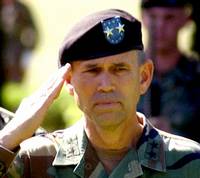
Major General John R.S. Bastiste

It's been called 'The Revolt Of The American Generals' and President Bush's White House crew talk about it like it means nothing, and that it's some kind of Democrats-fuelled conspiracy to undermine the Republicans.

But the 'Revolt Of The Generals' is very, very real, and it's spreading through the US Military.

The genesis came before the 'War On Iraq' even began.

And it began because Defence Secretary Donald Rumsfeld said there would be no insurgency in Iraq when all the best advice said that there would be one (and it would be bad) and the 'Revolt' set down deep roots inside the US Military when top generals' requests for more troops and better equipment to fight the 'War On Iraq' were refused by Rumsfeld from day one.

Below you will find quotes from Major General John R. S. Bastiste, who commanded the 1st Infantry Division in Iraq in 2004 and 2005 and was previously hailed by President Bush and Defence Secretary Donald Rumsfeld as a "true American hero".

Bastiste is now demanding Rumsfeld resign, and that he tell the truth of how he lied to Americans to get the war he wanted, regardless of the price of American, and Iraqi, blood.

Bastiste : "If we had seriously laid out and considered the full range of requirements for the war in Iraq, we would likely have taken a different course of action that would have maintained a clear focus on our main effort in Afghanistan, not fueled Islamic fundamentalism across the globe, and not created more enemies than there were insurgents."

...Rumsfeld "is not a competent wartime leader" and surrounded himself with "compliant" subordinates.

"Secretary Rumsfeld ignored 12 years of U.S. Central Command deliberate planning and strategy, dismissed honest dissent, and browbeat subordinates to build 'his plan,' which did not address the hard work to crush the insurgency, secure a post-Saddam Iraq, build the peace and set Iraq up for self-reliance...(Rumsfeld also) refused to acknowledge and even ignored the potential for the insurgency.

"At one point (before the war began), he threatened to fire the next person who talked about the need for a post-war plan.

"Secretary Rumsfeld's dismal strategic decisions resulted in the unnecessary deaths of American servicemen and women, our allies, and the good people of Iraq...He was responsible for America and her allies going to war with the wrong plan...."

To have a widely respected major general of Bastiste's standing make such public statements about the chief of the Pentagon, during war-time, was unprecedented before the 'War On Iraq'.

But Bastiste is not the first high-ranking Iraq veteran to call Rumsfeld to task for his deadly incompetency, and he won't be the last.

When Donald Rumsfeld was asked by journalists, yesterday, to reply to Bastiste's claims, he refused to answer.

When he was asked if he would resign, Rumsfeld swallowed heavily, mumbled "No" and then asked for the next question.

On television, Rumsfeld looked extremely worried.

As well he should be.

The 'Revolt Of The Generals' will continue to spread through the US Military until Rumsfeld is gone.

Go Here For The Full Story

How Bush And Rumsfeld Ruined The US Army

The Betrayal Of The American Military


Army's Top Officer Refuses To Submit War Budget To Rumsfeld - Revolt In The Open